Emergency Plumber in Fairfield, CA — 24/7 Response
Burst pipe, active leak, sewer backup, or no hot water? We answer the phone — a real person, not a call center — and can often be at your Fairfield home the same day.
Yes, we offer 24/7 emergency plumbing in Fairfield, CA, including burst pipes, active leaks, sewer backups, and no-hot-water calls. Emergency rates are disclosed upfront before any work starts — never buried in the final bill.
What Counts as a Plumbing Emergency?
Not every plumbing problem needs a 2am phone call, but some genuinely can’t wait until morning. If you’re not sure which category yours falls into, here’s a practical way to think about it: if water is actively flowing where it shouldn’t be, or you smell gas, treat it as an emergency and call immediately.
- Burst or actively leaking pipe
- Sewer backup into the home
- No hot water with a household that needs it
- Water heater leaking or making unusual noises
- Gas smell near an appliance or meter (leave the property, then call)
- Overflowing toilet that won’t stop
- Slab leak causing a sudden spike in water usage
What to Do While You Wait for Us
Shut Off the Water
If it’s a burst or leaking pipe, find your home’s main shutoff valve and turn it off to limit damage before we arrive.
Cut Power to Affected Areas
If water is near outlets or fixtures, shut off power to that area at the breaker if it’s safe to do so.
Move Valuables
Get furniture, electronics, and belongings away from the water while you wait.
Call Us
Tell us what you’re seeing — we can often narrow down the likely cause over the phone before we even arrive.
Why Fairfield Homes See These Emergencies
Fairfield’s mix of older housing stock and expansive clay soil creates specific emergency patterns worth knowing. Homes built between 1978 and 1995 often have polybutylene piping that can fail suddenly and without warning. Winter’s wet season saturates the clay soil under many Fairfield properties, which can stress pipe joints until they separate. And year-round, the mineral scale from our 9.2 GPG hard water quietly weakens water heaters and fittings until they finally give out — often at the worst possible time.
How fast can you get to my Fairfield home?
We prioritize active emergencies and can often be on-site same-day, including nights and weekends.
Are emergency rates disclosed upfront?
Yes. You’ll know the rate before we start — no surprise charges added to the final invoice.
What if I’m not sure it’s actually an emergency?
Call anyway. We’d rather talk you through it than have you wait on something that gets worse overnight.
Real Emergency Scenarios We Handle in Fairfield
“My pipe burst and water is spraying everywhere — what do I do first?”
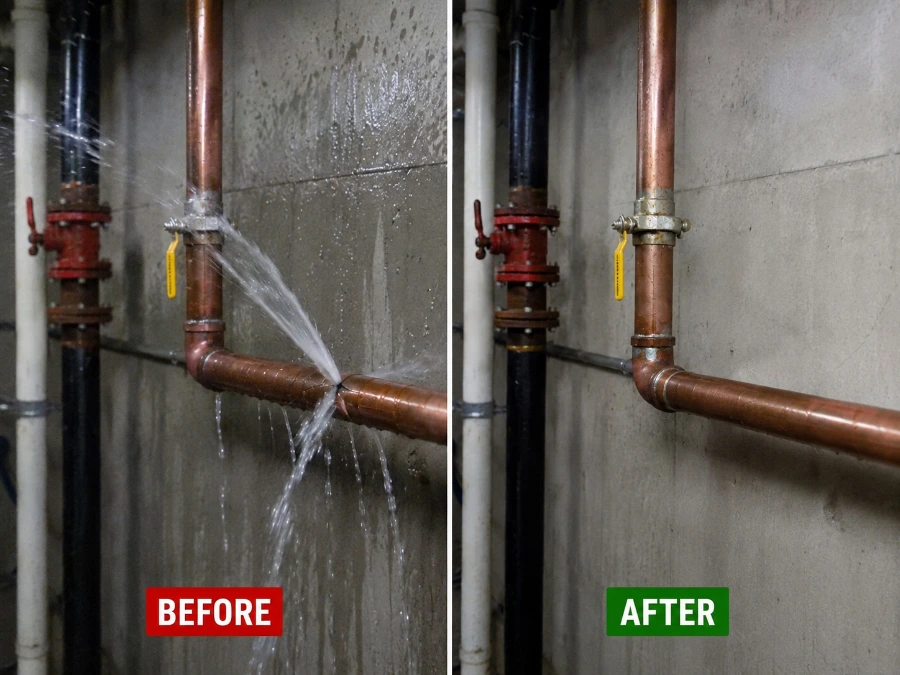
Shut off your home’s main water valve immediately — usually located near the water meter or where the line enters the house. This stops the flow while you call us. In older downtown Fairfield homes with galvanized supply lines, a sudden burst like this is often the final failure point of a pipe that’s been corroding from the inside for years without any visible warning.
“Water is backing up into my bathtub when I run the washing machine — is this an emergency?”
Yes, treat it as one. This is a classic sign of a main sewer line blockage, not a simple drain clog, and it typically gets worse quickly rather than resolving on its own. In Fairfield’s older, tree-lined neighborhoods this is frequently root intrusion into a clay or cast-iron lateral.
“My water heater is making loud banging noises and leaking — should I turn it off?”
Yes — shut off the power (electric) or gas supply to the unit and close the cold water inlet valve on top of the tank if it’s safe to reach. A leaking, noisy tank is often near full failure, and Fairfield’s hard water accelerates this kind of tank breakdown significantly.
Our Fairfield Service Area
We respond to emergency calls throughout Fairfield and greater Solano County, including Downtown Fairfield, Cordelia, Green Valley, Rockville, Paradise Valley, and the Travis AFB area.
Understanding Your Home’s Water Shutoff System
Every Fairfield home has a main water shutoff valve, and knowing exactly where it is before an emergency happens is one of the most useful things a homeowner can do for themselves. In most Fairfield homes, the main shutoff is located near where the water line enters the house — often in a garage, a utility closet, or near the water heater — and in some homes there’s also a street-side shutoff near the water meter, which requires a meter key or wrench to operate. Take a few minutes sometime when there isn’t an emergency to locate yours and confirm the valve actually turns; older valves that haven’t been operated in years can seize up, and discovering that during an actual emergency wastes precious time.
Beyond the main shutoff, most fixtures have their own local shutoff valves — under sinks, behind toilets, and at the water heater itself. Knowing these exist means you don’t always need to shut off water to the entire house for a localized problem; a leaking sink, for example, can often be isolated at its own valve while the rest of your home’s plumbing stays functional.
Breaking Down Common Fairfield Emergencies
Not all plumbing emergencies are the same, and understanding what’s actually happening helps you make better decisions while you wait for us to arrive.
Burst pipes in Fairfield most often trace back to one of two causes: corroded galvanized supply lines in older downtown homes finally failing after decades of internal narrowing, or polybutylene pipe from the 1978–1995 building era degrading and splitting without much warning. Either way, the fix is the same first step — shut off the water immediately to limit the damage.
Sewer backups are frequently caused by root intrusion into older clay or cast-iron sewer laterals, especially in tree-lined neighborhoods. A backup that affects multiple fixtures at once — rather than just one slow drain — is a sign the blockage is in the main line, not a single fixture’s trap.
Water heater failures that show up suddenly, rather than gradually, are usually a specific component failure (a thermocouple, heating element, or pressure relief valve) rather than the whole unit dying at once. These are frequently same-day fixable rather than requiring a full replacement.
Slab leaks rarely present as a dramatic emergency — they show up as a rising water bill or a warm spot on the floor. But once identified, they’re worth treating with urgency since Fairfield’s clay soil means the underlying cause (seasonal ground movement) doesn’t resolve itself.
What Happens When You Call Us for an Emergency
We Answer — A Real Person
No automated menu, no call center reading from a script. You describe what’s happening and we start narrowing down the likely cause immediately.
Immediate Guidance
We’ll walk you through what to do right now — shutoff location, what to avoid — while we prepare to head your way.
On-Site Diagnosis
We identify the actual cause, not just the visible symptom, before recommending a fix.
Written Emergency Rate
You’ll know the cost before we start work, even outside normal hours.
The Real Cost of Waiting on a Plumbing Emergency
It’s tempting to wait out a plumbing problem overnight, especially if it happens late or seems manageable in the moment. In practice, delay is usually what turns a moderate repair into an expensive one. A slow leak left overnight can saturate flooring and subflooring, turning a plumbing repair into a flooring and drywall repair as well. A sewer backup that isn’t addressed can push sewage further into a home the longer it continues. A water heater making unusual noises that’s ignored can progress from a repairable component failure to a full tank rupture. None of this means every plumbing issue is a crisis — but the ones that genuinely are tend to get more expensive, not less, with time.
Seasonal Emergency Patterns in Fairfield
Fairfield’s plumbing emergencies follow a rough seasonal pattern tied to the city’s Mediterranean climate. Winter’s wet months saturate the area’s expansive clay soil, which stresses pipe joints and is a factor in both slab leaks and sewer lateral separations — December through February tends to see more of these calls. Summer’s heavy hot-water demand and general household activity puts more cumulative strain on water heaters already weakened by hard-water scale, making late spring through summer a common season for water heater failures. Fairfield doesn’t see the freeze-related burst pipes that colder regions deal with, since temperatures here rarely drop below freezing — our burst-pipe emergencies are almost always corrosion or material-failure driven rather than weather-driven.
Common Questions About Emergency Plumbing in Fairfield
Is there an extra charge for emergency calls outside business hours? Emergency rates apply outside standard hours, and you’ll know the exact rate before we start — it’s disclosed upfront, never added as a surprise to the final bill.
What if I turn off the water but the leak keeps going? If shutting the main valve doesn’t stop it, the source may be on the street side of your shutoff — tell us this when you call so we can prioritize accordingly.
Can a plumbing emergency really happen at 2am? Yes — pipe failures, water heater ruptures, and sewer backups don’t wait for business hours, which is exactly why we answer calls around the clock.
Where is my home’s main water shutoff valve likely located?
Usually near where the water line enters the house — often in a garage, utility closet, or near the water heater. We recommend confirming yours before you need it.
Should I try to fix a burst pipe myself before you arrive?
Focus on shutting off the water and moving valuables away from the area — leave the actual repair to us rather than attempting a patch that could complicate the real fix.
How do I know if a sewer smell means an emergency?
A persistent sewage smell combined with slow or backing-up drains is worth calling about promptly rather than waiting to see if it resolves on its own.
Do you charge a trip fee for emergency calls that turn out to be minor?
We’d rather you call and find out it’s manageable than not call and have it get worse — ask about pricing specifics when you reach out.
Preparing Your Fairfield Home Before an Emergency Happens
A little preparation goes a long way when something does go wrong. Beyond knowing your shutoff valve location, it’s worth keeping a small emergency kit near your main water shutoff — a flashlight, a pair of channel-lock pliers or an adjustable wrench sized for your valve, and a few old towels. If your home has an older or original shutoff valve that’s never been tested, consider having it checked during a routine service visit rather than waiting to discover it’s seized during an actual emergency; we can also install a more accessible or easier-to-operate shutoff if your existing one is hard to reach.
For households with elderly residents or anyone who might have difficulty operating a stiff valve quickly, it’s worth having a family member or neighbor who knows the shutoff location as a backup. And if you’re a landlord or property manager with tenants in a Fairfield rental, making sure tenants know where the shutoff is — and have a number to call — can meaningfully reduce damage in the time between a leak starting and a professional arriving.
Why Older Fairfield Homes See More Emergency Calls
Age isn’t destiny when it comes to plumbing emergencies, but it is a real factor. Homes built before 1960 in downtown Fairfield often still have original galvanized steel supply lines, which corrode from the inside out over decades until a section finally fails — usually without much warning since the corrosion is happening inside the pipe, invisible from outside. Homes built during the 1978–1995 window may have polybutylene piping, a material that was widely used at the time but is now known to degrade with prolonged chlorine exposure and can fail suddenly rather than gradually. Neither of these issues is something a homeowner can inspect for without professional help, which is part of why we recommend a pipe-material check as part of routine service for homes in either era — catching a weakening section before it fails is a lot less disruptive than an emergency call at 2am.
Emergency Plumbing for Fairfield Renters and Landlords
Plumbing emergencies in rental properties come with their own wrinkle: tenants need a fast response, and landlords need clear communication about what happened and what it costs. We work directly with both — responding to a tenant’s emergency call while keeping the property owner or manager informed, and providing the kind of written documentation that’s useful for insurance claims or simply keeping records straight. This matters particularly in areas of Fairfield with a higher share of rental turnover, where a fast, well-documented emergency response protects both the tenant’s immediate situation and the landlord’s property.
When to Call an Emergency Plumber vs. Wait for a Regular Appointment
Plenty of plumbing issues are genuinely urgent but don’t require an after-hours emergency call — knowing the difference can save you money on emergency rates while still getting the problem handled promptly. A slow drain, a toilet that runs occasionally, or a faucet with a minor drip can typically wait for a same-day or next-day standard appointment without meaningful risk. The line shifts firmly toward “call now” when water is actively flowing somewhere it shouldn’t, when a gas smell is present, when sewage is backing up into living space, or when a water heater is visibly leaking or making alarming sounds. If you’re ever unsure which category your situation falls into, calling and describing what you’re seeing is the fastest way to find out — we’d rather help you triage over the phone than have you guess wrong in either direction.
After the Emergency: What We Leave You With
Once the immediate emergency is resolved, we don’t just pack up and leave you guessing about what happened. You’ll get a clear explanation of what caused the problem, what we did to fix it, and — where relevant — whether it points to a larger issue worth addressing before it becomes another emergency. If a burst pipe turned out to be one failure point in an otherwise aging galvanized system, we’ll tell you that honestly rather than letting you assume the problem is fully behind you. That kind of straightforward follow-up is part of how we work every job, not just the emergency ones.